
This article is bilingual: English and Irish, paragraph by paragraph / Alt dátheangach atá anseo: Béarla agus Gaeilge, mír ar mhír.
We’ll soon be publishing our latest book, Height for Hire // Suas sa Spéir. It’s the story of a boy, a kite, and a giraffe who comes to help when the kite gets stuck in a tree. It’s gentle, playful and full of imagination — and on top of that, it’s wordless.
Beidh an leabhar is nuaí dár gcuid, ‘Height for Hire’ // ‘Suas sa Spéir’, á fhoilsiú againn go luath. Is scéal é faoi bhuachll, eitleog, agus sioráf a thagann chun cabhrú leis an mbuachaill nuair a théann a eitleog i bhfostú i gcrann. Scéal séimh spraíúil samhlaíoch atá ann — agus sa mhullach air sin, scéal balbh atá ann.

*
Wordless books are sometimes misunderstood. We tend to use vague words like universal, accessible, and imaginative when we talk about them. But what does that really mean? Why would you bother writing one, publishing one — or even reading one?! For us, the answer is simple. They create an experience no other kind of book can offer.
Uaireanta bíonn míthuiscint ar leabhair bhalbha. Úsáidimid aidiachtaí teibí ar nós ‘uilíoch’, ‘inrochtana’, ‘samhlaíoch’ agus muid ag cur síos orthu. Cad is brí leis sin i ndáiríre? Cén fáth a mbacfaimis le ceann a scríobh, a fhoilsiú, nó a léamh? Freagrsa simplí atá ann, dar linn. Cruthaíonn siad eispéireas nach ndéanann aon leabhair eile.
*
Of course, we love picture books and sound books even more so! But wordless books are something else entirely. With picture books, adults usually read and children listen. The text draws our eyes and pulls us forward. We miss the details. But with wordless books, you stop. You stay. You look. You talk. You notice expressions. You notice what the characters are doing. You notice the little things. These are things readers often don’t experience.
Is aoibhinn linn pictiúrleabhair, ar https://myirishbooks.ie/product/crann-na-nguionna/ndóigh. Agus fuaimleabhair níos mó fós! Ach tá rud éigin speisialta, go hiomlán éagsúil, ag baint le leabhair bhalbha. Le pictiúrleabhair, léann an duine fásta agus éisteann an páiste. Dírímid ár súile ar an téacs. Tarraingíonn sé leis muid. Ní thugaimid na mionsonraí faoi deara. Ach le leabhair bhalbha, stopann sibh. Fanann sibh. Féachann sibh. Labhraíonn sibh. Tugann tú dreacha faoi deara. Tugann tú faoi deara céard atá ar siúl. Tugann tú na mionsonraí faoi deara. Rudaí iad seo ar minic nach dtéann léitheoirí i dtaithí orthu.
*
I think of The Crazy Kitchen by Roger Blachon. You could spend an hour looking at it and spotting new details every few seconds. But if it was part of a story, however, and words such as “They opened the door and looked inside. They couldn’t believe their eyes…” were words on the page – would we notice everything or would we move on quickly?
Smaoiním ar an bprionta ‘An Chistin Chraiceáilte’ le Roger Blachon. D’fhéadfá uair a chloig a chaitheamh ag féachaint air agus sonraí nua á dtabhairt faoi deara gach cúpla soicind. Dá mbeadh sé ina chuid de scéal, áfach, agus focail ar nós “D’oscail siad an doras agus d’fhéach siad isteach. Ní raibh siad in ann a súile a chreidiúint” le feiceáil ar an leathanach, an dtabharfaimis gach sonra faoi deara nó an mbogfaimis ar aghaidh leis an téacs?
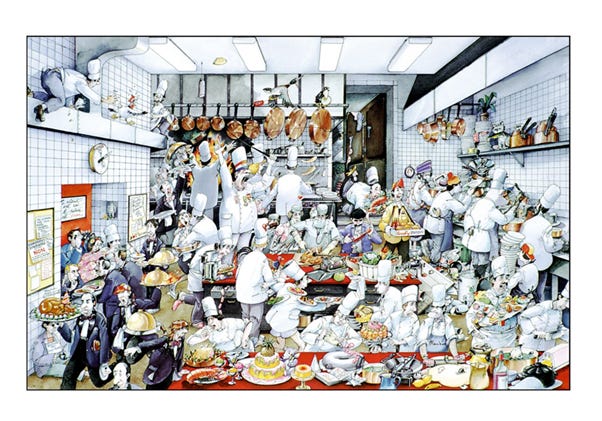 La Cuisine en Folie by Roger Blachon
With Tatyana’s book, we stop – and we talk.
The child starts: “Look at this! Look at that!”
The adult asks: “Is he sad or happy? Why do you think that is?”
“What’s that above his head? Why’s it there?”
It’s no longer just reading – it’s a real conversation. A story built together, even.
I leabhar Tatyana, stopaimid – agus labhraímid.
Tosaíonn an páiste an comhrá: ‘Féach air seo, féach air sin!’
Cuireann an duine fásta ceisteanna orthu – ‘An bhfuil brón nó áthas air? Cén fáth, meas tú?’
“Cad é sin os cionn a chinn? Cén fáth a bhfuil sé ann?”
Ní seisiún léitheoireachta é a thuilleadh – is comhrá fiúntach é. Comhthógáil scéil, fiú.

*
At My Irish Books, we believe in this kind of accessibility. It links in with our other books too – and we’ll talk more about that in our next post. We’ll also hear from Tatyana too.
Creidimid in ‘My Irish Books’ san inrochtaineacht seo. Nascann sé lenár leabhair eile freisin agus labhróimid níos mó faoi sin sa chéad snáithe eile. Labhróimid le Tatyana freisin.


